Enrique Ortega Gironés, international mining consultant
Original publication (in Spanish, Entrevisttas.com)
Since several months ago there has been a significant increase of news related to the Spain’s mining potential in media coverage. This increase is due to the recent shift in the European Union’s view on mining activities. The radical change began with the creation of a list of strategic and critical minerals on which Europe was heavily dependent on foreign supplies. Then, to address the identified shortcomings, the European Critical Raw Materials Act was passed in an attempt to stimulate the search for these minerals in European territory. This initiative has been supported in Spain with the development of an Action Plan for the Sustainable Management of Mineral Raw Materials, currently in the public information phase. Complementarily, the European Commission officially announced its support for 47 strategic projects focused on critical raw materials, seven of which are in Spain. These projects represent the vanguard of a plan that will be expanded to include new projects and whose objective is to reduce dependence on the supply of strategic minerals by 10% within ten years.
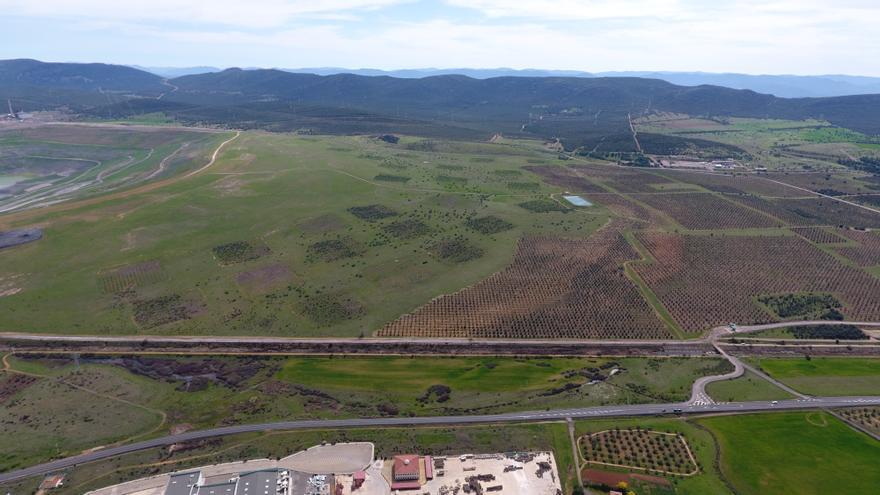
Rehabilitated landscape of a large coal open pit (Emma Mine) near Puertollano, Ciudad Real province. The ancient hole has been filled-up with the sterile rocks and the original soil (previously removed) has been reinstalled in its original place and now is an olive tree plantation.
This sudden change is nothing less than an acknowledgement that the policy pursued for decades has been misguided. The consequences of this mistake and the fragility of the supply of mineral raw materials are now being felt. Better late than never, of course, but it must also be said that these decisions are necessary but not sufficient. Correcting the situation of neglect that has existed for years requires sustained and continuous effort, as well as stable long-term planning. To properly understand why this is necessary, the specific characteristics of the mining sector, which are completely different from those of other industrial and economic activities, must be considered.
Firstly, it must be considered that the search for and exploitation of mineral deposits is an expensive and risky investment, in which only 1% of costly exploration projects (this is the global average for the last few decades) culminate in the discovery of an exploitable mine. Furthermore, the only way to recoup the high costs of searching for deposits is to exploit the minerals discovered. This is also an inevitably slow process. The minimum period from the start of exploration to the extraction of the first tonne of ore (assuming that sufficient reserves are found and the economic viability of the deposit is verified) is ten years, again based on global average values over the last few decades.
Given these specificities, it is worth asking whether the measures adopted (the implementation of the strategic projects already selected and those that will follow in the future) significantly reduce dependence on the supply of the required minerals. There is no doubt that these projects are an emergency solution, to be implemented quickly to alleviate existing shortages as immediately as possible. But is it enough to set a target of reducing dependence by only 10%? Does this limited percentage really solve the problems of European industry? Does the mining potential of our subsoil not allow us to set more ambitious targets and achieve a much greater degree of autonomy?
The projects selected by the EU do not correspond to new findings or recent discoveries. In the case of Spanish projects, lithium in Orense and Cáceres, tungsten in Cáceres and Ciudad Real, cobalt and nickel in Badajoz, and copper in Seville, they focus on long-known deposits that have been inactive for years or are trying to start exploitation. To this initial list should be added equally inactive deposits of strategic minerals, such as the El Retortillo uranium mine in Salamanca (meanwhile, Spain continues to import from Russia the fuel for their operating nuclear plants), the coltan deposit in Penouta (Orense) and the rare earths in Ciudad Real, as well as the important gold deposit in Salave in Asturias, among others.
Furthermore, in addition to these already known deposits and, at least as far as the Spanish subsoil is concerned, the existing potential for copper, tungsten, uranium, lithium and rare earth minerals would allow for much more ambitious targets than the proposed 10%, provided that the necessary efforts were made to explore and discover new deposits. Because, despite the long mining history in Spain, it should not think that everything is already known and that there is nothing left to discover. The remarkable advances made in recent years in exploration techniques, particularly geophysics, have led to the discovery of new deposits worldwide in places previously considered barren. Added to this are the new types of minerals that are now being sought, and which had never been prospected before. Both factors combined, considering that mining exploration has been practically non-existent in Spain for decades, mean that a large part of our territory can now be considered underexplored.
Given this potential, if it is really intended to significantly reduce the dependence on strategic raw materials, it must be promoted the search for new deposits, bearing in mind that minerals that begin to be explored today will not be available for at least ten years later. But how this search can be stimulated and encouraged? International experience accumulated over recent decades indicates that two essential conditions are necessary. Firstly, the availability of sufficient geological and metallogenic knowledge of the subsoil to attract interest and focus exploration objectives. And secondly, clear, stable, reliable, transparent and fast procedures to access and to maintain mining concessions (Ortega et al., 2009).
About the first of these conditions, Spain has an excellent subsoil knowledge, managed by one of the oldest and prestigious geological services in the world, the IGME (Geological and Mining Institute of Spain). This institution was created more than a century and a half ago, focussed on the mining industry as essential institutional obligation. However, in parallel with the decline in mineral exploitations experienced in Spain since 70’s, the interest in mining suffered a serious decline.
About the second condition, it must be also taken in consideration the changes implemented in the public administration of the mining sector, where its importance has been reduced to lower echelons in the governmental organization hierarchy. In fact, it practically disappeared at national level because the responsibilities have been transferred to the autonomous communities. Under these conditions, it is worth asking whether the current Spanish administrative organisation has sufficient operational capacity to manage the activities that would enable to achieve the Action Plan proposed objectives.
This situation seriously affects the second condition mentioned above, namely stability and clarity for application, granting and maintenance of mineral licenses. In addition to the mentioned administrative difficulties, it should be pointed that the projects selected as strategic by the EU in Spain are in fact blocked by outright opposition coming from minoritarian but very active and aggressive environmental platforms. Such opposition is mainly based on arguments that are technically debatable and presented from a confrontational stance, where there seems to be no room for dialogue. Despite the apparently technical weakness of their arguments, reality demonstrates that such kind of opposition is very efficient.
It is obvious that the systematic blocking of any mining project in Spain is a legacy of previous European environmental policy, which during decades has encouraged attitudes opposed to mining, preferring to import mineral raw materials from third countries, leading to the present situation. And although the official European Union’s views on mining have recently evolved, the positions of anti-mining platforms have not changed. Politicians forget that social inertia makes very slow the changes in mentalities, which cannot be modified sharply by approval of new acts and regulations. The mentality against mining has been instilled in the social consciousness over many years and cannot be erased at a stroke by a simple decree. Something similar could be said about the social opinion about atomic energy, demonized during decades and passed recently to be considered as green energy. However, most of the people still is afraid by atomic energy and in spite of the critical situation for energy production, operational atomic plants are going to be closed.
Then, considering the present reality, it is pertinent to ask if Spain can be considered today as an attractive country for mining investment, even bearing in mind the urgent need for it. Can a company make investments in exploration if it runs a high risk of losing its assets by not being able to access the exploitation of the discovered resources? The mentioned Action Plan will not be able to achieve its objectives (let alone expand to more ambitious goals) if it is not accompanied by the necessary human, technical, material and organisational resources. And above all, the most essential factor is the firm political decision for implementing a new mining policy, reversing the passivity and laziness shown for decades. What security of tenure can expect a mining titleholder if his operation plan, approved by the administration, can be blocked by a local platform operating at municipal level? This is the case, for instance, of the uranium Retortillo deposit (Salamanca province) hold by Berkeley. The mine was in the planning stages and has been halted after significant public mobilisation. Berkeley has argued that the Spanish government violated the Energy Charter Treaty (ECT), has requested international arbitration to resolve the dispute and presented and led the company to sue Spain for approximately €900 million. Similar blocked situation is experiencing the exploration concessions for rare earths in Ciudad Province, where important rare earths reserves have been discovered.
In recent years, there has been a clear decline in the European industrial sector, which was 20% of the eurozone economy in 2000 and is now merely 13%. According to Eurostat, industrial production fell by 2.2% between 2023 and 2024. However, our politicians do not seem concerned and proudly proclaim that Europe is leading the fruitless green transition. It is obvious that the industrial policy implemented during last decades has been wrong, and one substantial part of this error is rooted in the strategic mineral supply, as demonstrated by the recent abrupt change of direction in European mining policy.
However, the new policy will be useless if is not properly implemented and the required projects are being systematically blocked. The nearly generalized opposition against mining activities is being regularly based on obsolete environmental arguments, ignoring the modern technology permitting the exploitation of mineral resources in a compatible way with the environmental preservation. Many of the reasonings put forward by anti-mining platforms could be easily refuted if, beyond individual actions, the geological researching institutions and official mining entities would introduce in the public debate (with a firm, coherent and responsible stance towards the public) the enormous amount of available data and information stored in their files. At Spanish level, the technical and scientific information accumulated by studies carried out by institutions such as the IGME, the Nuclear Safety Council, universities and professional associations of geologists and mining engineers would make possible to refute the biased arguments of anti-mining platforms. Without this firm political resolve, it will be impossible to reverse the present trend and to achieve the responsible exploitation of available resources. Without this change of course, there is a risk that all the efforts being made will be nothing more than empty promises and failed attempts.
References:
Ortega, E., Pugachevsky, A. & Walser, G. (2009).- Mineral Rights Cadastre, Promoting Transparent Access to Mineral Resources. Extractive Industries for Development Series #4. The World Bank.
Addendum SCE
Científicos españoles desafían el alarmismo climático y recuerdan que « sin debate, no hay ciencia »